

Edge AI is becoming one of the more important infrastructure stories in artificial intelligence, and recent news from Spectrum offers a clear example of why. At SCTE TechExpo 26 in Atlanta, Spectrum, the broadband business of Charter Communications, showcased an expanded Edge Compute Infrastructure (ECI) platform designed to place accelerated AI computing much closer to users, devices, sensors, and machines. The announcement brings together NVIDIA computing technology and new commercial relationships with Cast AI, HP, Hydra Host, and World Wide Technology, providing a real-world look at how telecommunications infrastructure could become part of the next generation of distributed AI.
Spectrum says its existing network gives it access to more than 1,000 smaller edge data centers and related facilities across the United States. The company claims this footprint can place distributed computing capacity within 10 milliseconds of roughly 500 million connected devices in homes and businesses. Spectrum repeated those figures in its September 2026 announcement, making this a particularly timely example of how companies are trying to move AI computing away from exclusively centralized facilities.
Why Spectrum Is Moving AI Compute to the Network Edge
Cloud data centers remain fundamental to artificial intelligence. Large GPU clusters are particularly well suited to model training, large batch-processing jobs, centralized data storage, and workloads that do not require immediate responses. But an increasing number of AI applications operate in the physical world. Robots, cameras, industrial systems, sensors, interactive applications, and other connected devices continuously produce data and often need decisions quickly. Sending every piece of that information to a distant cloud region can add network latency and consume substantial bandwidth. Edge computing offers another option: move some of the compute closer to where the information is generated.
In broad terms, edge AI can provide several benefits depending on the application:
- Lower latency by shortening the network path between data sources and computing resources.
- Less unnecessary data movement when raw sensor or video data can be processed near its source.
- More flexible workload placement across devices, local servers, edge facilities, and centralized clouds.
- Greater control over certain data when organizations have reasons to process information locally.
- Better support for real-time applications such as machine vision, robotics, interactive media, and industrial automation.
Edge AI is therefore less about replacing the cloud than deciding which part of an AI workload should run where.
More Than 1,000 Facilities Could Become AI Compute Locations
What makes Spectrum’s announcement especially interesting is that the company already possesses much of the physical footprint required for distributed computing. Spectrum has spent years building broadband infrastructure throughout the country. Instead of constructing an entirely new nationwide network of AI facilities, its ECI strategy seeks to activate compute resources at smaller locations already embedded within that network.
The company says its ECI platform combines these distributed facilities with its high-capacity fiber infrastructure and NVIDIA accelerated computing.
Spectrum had already outlined this strategy earlier in 2026. In March, it announced an edge deployment using the NVIDIA AI Grid reference design and said its network could scale to hundreds of megawatts of computing capacity across more than 1,000 edge data centers and hubs. That earlier deployment included NVIDIA RTX PRO 6000 Blackwell Server Edition GPUs and demonstrated remote graphics rendering as one low-latency use case.
This latest announcement takes that concept further by emphasizing AI applications and commercial partnerships rather than simply demonstrating the infrastructure.
NVIDIA Provides the Accelerated Computing Foundation
GPU computing is a major part of Spectrum’s ECI strategy. The current platform incorporates NVIDIA accelerated computing, while Spectrum’s earlier work used NVIDIA’s AI Grid design to support distributed GPU resources over its fiber network.
That combination of networking and accelerated compute illustrates an important point about edge AI: the processor alone does not determine performance. Bear in mind that AI systems also depend on memory, storage, network throughput, latency, workload scheduling, cooling, power availability, and the location of the compute relative to the application.
A large centralized GPU cluster can be ideal for training a model. An inference workload controlling machinery or processing live video may have very different requirements. The goal is increasingly to place computing resources according to the needs of the workload rather than assume that every AI task belongs in the same type of facility.
Spectrum’s Partners Show Different Uses for Edge AI
The TechExpo announcement includes several companies approaching distributed computing from different directions. Spectrum is working with Cast AI, HP, Hydra Host, World Wide Technology, and NVIDIA to demonstrate or commercialize uses of its ECI platform.
Cast AI, for example, plans to integrate NVIDIA Blackwell Ultra-based resources hosted by Spectrum into its OMNI multi-cloud fabric. The goal is for those distributed GPUs to function as compute nodes alongside capacity from major cloud providers.
| Company | Role in Spectrum’s Edge AI Initiative |
| NVIDIA | Provides accelerated computing technology supporting Spectrum’s distributed AI infrastructure |
| Cast AI | Connects Spectrum-hosted GPU resources to its OMNI multi-cloud compute environment |
| HP | Demonstrates shared GPU access and systems intended for enterprise edge AI development |
| Hydra Host | Plans to use Spectrum-owned ECI capacity through its AI infrastructure platform |
| World Wide Technology | Demonstrates physical AI and robotics using distributed edge infrastructure |
That model points toward a future in which developers may not need to think of edge and cloud computing as completely separate environments. Instead, workloads could potentially be scheduled across different infrastructure according to performance, location, cost, and availability.
HP and Hydra Host Add a Commercial Dimension
HP is also using the Spectrum showcase to demonstrate technology related to distributed GPU access.
According to the announcement, HP Z Boost is designed to provide shared, on-demand access to GPU resources for workloads including AI, visualization, and rendering. HP is also demonstrating its ZGX Nano and ZGX Fury systems, which Spectrum describes as platforms for enterprise edge AI development.
Hydra Host represents another part of the emerging ecosystem. Spectrum says Hydra Host has an agreement allowing its AI Factory platform to use computing capacity owned, hosted, and operated by Spectrum.
Together, these partnerships suggest that Spectrum is not merely experimenting with GPUs inside its network. It is testing ways to make distributed resources available through cloud-management, hardware, and AI infrastructure platforms that enterprises already use.
A Humanoid Robot Shows Why Edge Latency Matters
One of the most visible demonstrations at SCTE TechExpo 26 involves robotics.
World Wide Technology is showing a Unitree G1 humanoid robot as part of a collaboration involving Spectrum and NVIDIA. The demonstration is intended to illustrate how distributed edge computing can support robotics and industrial automation. Robotics is a useful illustration of why edge computing matters.
A robot can generate data from cameras, sensors, motors, and other systems continuously. Some processing is performed directly onboard the robot, while other workloads may be handled by nearby computers or more distant infrastructure. For time-sensitive functions, network latency can become an important design constraint.
That does not mean every robotic AI calculation should move to an edge data center. Rather, robotics demonstrates the broader architectural principle behind edge AI: processing can be divided among the device, nearby computing systems, regional infrastructure, and centralized clouds depending on how quickly results are needed and how much data must move.

Edge AI Is Not a Replacement for the Cloud
It is important not to turn the current edge trend into an edge-versus-cloud argument. Centralized data centers remain critical for AI, especially for computationally intensive training, large datasets, batch processing, and workloads that benefit from enormous pools of shared accelerators.
Edge computing serves a different role. A machine-vision system might analyze video locally and send only important events to a centralized platform. A factory could perform real-time inference near production equipment while using a cloud environment to retrain models. An organization could keep latency-sensitive operations close to users while directing less urgent processing elsewhere.
The result is a distributed AI architecture, rather than a wholesale migration away from centralized infrastructure.
The Opportunity Still Has to Prove Itself
There is also an important business caveat. The investment-focused article supplied for this story notes that Charter continues to face broader questions surrounding broadband competition and subscriber trends. It argues that the edge-computing initiative creates an interesting new use for Charter’s network but does not by itself resolve those near-term business pressures.
That is an important distinction.
Having more than 1,000 potential edge facilities is a substantial infrastructure advantage, but turning those locations into a profitable AI computing business requires customers, high utilization, reliable orchestration, sufficient power and cooling, security, operational support, and competitive pricing.
The technology opportunity is real. The ultimate business impact remains to be demonstrated.
What Spectrum’s Announcement Means for the Edge AI Market
For companies operating in the edge-computing ecosystem, the more important story is where this is all headed.
AI computing is becoming geographically distributed. Network providers are exploring GPU capacity inside telecommunications infrastructure. Hardware companies are developing systems for AI outside traditional hyperscale facilities. Software platforms are trying to make edge resources accessible alongside cloud capacity. And industrial applications are creating demand for computing that sits closer to machines and data.
That trend is directly relevant to companies such as NextComputing, which develops high-performance systems capable of bringing substantial compute resources into edge and specialized environments.
Spectrum’s latest ECI announcement does not mean centralized AI data centers are going away. It demonstrates something more practical: AI infrastructure is expanding beyond them.
Summary
Edge AI is evolving from individual deployments into a broader infrastructure strategy. By combining more than 1,000 potential edge locations with fiber connectivity, NVIDIA accelerated computing, and partners spanning cloud orchestration, hardware, AI infrastructure, and robotics, Spectrum is testing how a nationwide network can become a distributed computing platform.
The economics and ultimate market adoption still need to be proven, but the underlying trend is increasingly clear: as AI becomes more connected to real-time devices and physical systems, where computing happens will matter almost as much as how much computing power is available.
The Right Hardware Platform
The ideal system for AI workloads offers the performance to handle compute-intensive tasks and the flexibility to build and expand to match your specific needs. This is where NextComputing excels with a variety of high-performance solutions built for any environment.
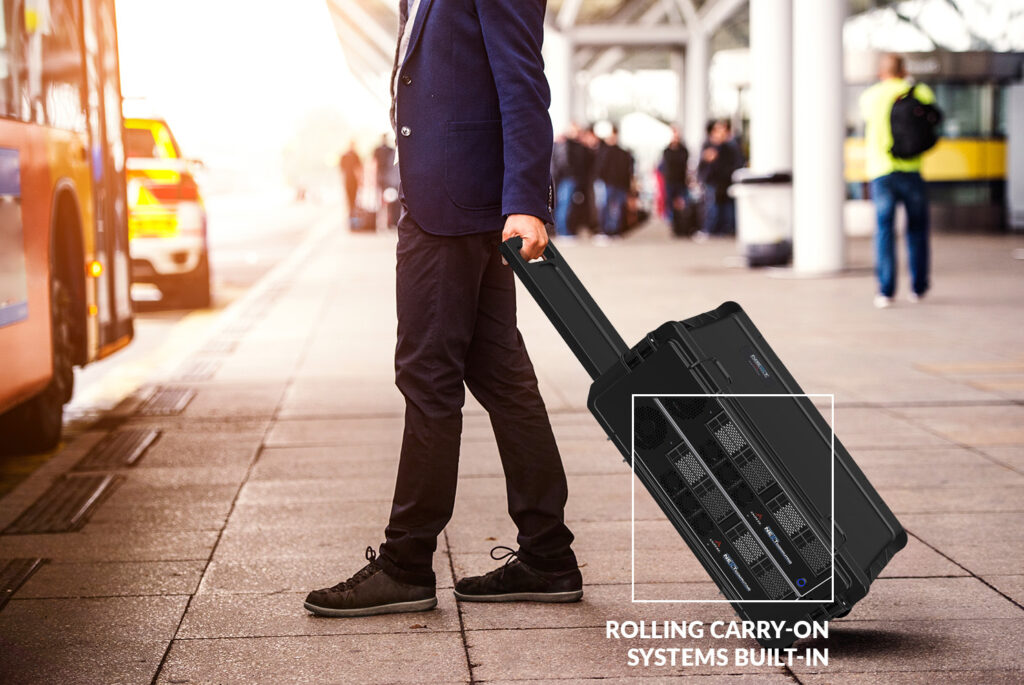
Fly-Away Kits
NextComputing Fly-Away Kits (FAKs) are a self-contained suite of equipment (hardware and software) in a compact, portable form factor for a variety of use cases where location and portability are key factors.
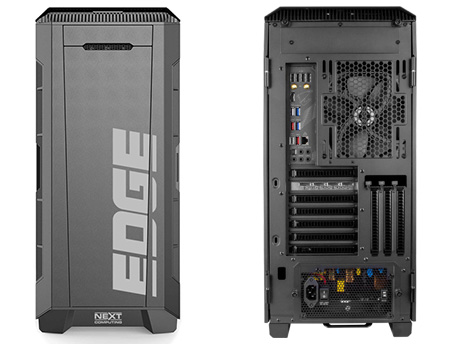
Edge XTP
The Edge XTP tower workstation is a professional-grade platform powered by the Ampere family of high-performance, scalable, power-efficient processors for demanding data-intensive, edge and cloud applications

NextServer-X 2U
The intelligent, compact design of the NextServer-X 2U allows for both easy transport and expandability. Whether you need cyber analytics in the field, or the flexibility to grow your toolset with your changing needs, the NextServer-X 2U deployable server lets you bring your server applications to the network edge.