

Edge AI reduces latency by performing data processing and AI inference directly on local edge devices, such as IoT sensors or smart cameras, rather than transmitting data to remote cloud servers. This localized computation minimizes network transmission delays, enabling faster real-time decision-making in time-sensitive applications.
Using Edge AI to Reduce Latency
When we talk about latency, we’re really referring to the delay between when data is generated and when a decision or response happens. Traditionally, many AI systems rely on sending data to centralized cloud servers for processing. This involves transmitting raw data over networks, waiting for the servers to analyze it, then receiving instructions back. Even with today’s high-speed networks, this round trip can add meaningful delay, especially when data must travel to a remote cloud region and back before a response is triggered.
What Edge AI does differently is shift the computation right to the source: the edge device itself. Rather than depending entirely on distant cloud infrastructure, these systems may use CPUs, GPUs, NPUs, TPUs, FPGAs, or other edge AI accelerators to run inference locally. This means sensor data, like video feeds from a smart camera or readings from an industrial IoT sensor, is processed immediately without that travel time.
The impact on latency can be significant when the hardware, model, and deployment architecture are designed for the application. Edge AI can support time-sensitive functions such as local anomaly detection, machine-vision inspection, equipment monitoring, and assisted-driving features, but actual response times vary by system.
Of course, achieving these low-latency benefits depends heavily on the right hardware and algorithms optimized for edge operation. Devices need sufficient computing power paired with efficient AI models that balance speed and accuracy without draining batteries or overheating.
It’s also worth noting that Edge AI significantly reduces network congestion by limiting how much raw data needs to travel across connections. For example, instead of streaming continuous video to a server, an edge device might only send alerts or summarized information after local analysis, a strategy that further improves overall system responsiveness.
Some critics point out that cloud-based AI can leverage far greater computational resources, potentially delivering deeper insights or more complex analytics. However, this advantage often comes at the cost of increased latency, which is unacceptable for time-sensitive applications like medical monitoring or collision avoidance systems. Edge AI strikes a vital balance by providing competent processing power where it counts most, in real time.
For applications that require immediate feedback and action, Edge AI should be evaluated as part of the architecture. By keeping critical data close and computing on-site, organizations not only gain faster responses but also enhance security by minimizing transmission of sensitive information. With latency reduced through local processing, edge AI can support applications that need faster response times than cloud-only architectures can consistently provide.
Core Principles of Edge Computing
At its heart, edge computing means shifting the heavy lifting, the data processing, closer to where the action happens. This simple relocation tackles some significant challenges that come with sending everything back and forth to distant cloud servers.
When you imagine a sprawling network where sensors constantly pump out data, the idea isn’t to funnel all of it through a congested highway but rather create smaller, local routes that keep traffic flowing smoothly.
The first key principle is proximity. It’s about processing data near its source. Think of a security camera on a factory floor. Instead of relaying every frame to a faraway server, which could introduce delays or even lose frames when connectivity falters, the edge device processes video locally. This proximity can reduce data travel time and help lower overall latency.
The result? Lightning-fast responses and decisions made just in time.
But proximity alone doesn’t tell the whole story. Edge computing thrives on decentralization, spreading tasks across multiple devices rather than relying on a single central hub. Instead of one massive data center juggling everything, you have a fleet of smart devices working in tandem.
This distribution can reduce bottlenecks and improve resilience, although failover depends on how the system is designed, monitored, and orchestrated. So when an urgent problem arises, response times are swift because local resources act immediately without waiting for orders from afar.
A third principle, real-time processing, embodies the promise behind edge computing’s rise. Whether it’s autonomous vehicles navigating busy streets or industrial sensors detecting equipment failures, waiting seconds, or even fractions thereof, is unacceptable.
Local computation empowers devices to analyze incoming data right away and act without delay. In certain applications, faster local detection can support safety-critical workflows by triggering alerts, shutdowns, or other predefined responses sooner than a cloud-only workflow might. Real-time feedback ensures systems remain agile and responsive to rapidly changing conditions, eliminating frustrating lags inherent to cloud-dependent architectures.
Lastly, scalability ensures edge computing is not just fast but flexible. Edge deployments must grow and adapt as demands shift, imagine smart city networks that scale up during events or seasons with heavy traffic. By distributing workloads over many devices and allowing dynamic resource allocation, edge architectures accommodate expansion without sacrificing performance.
| Principle | What It Means | Why It Matters |
| Proximity | Data processed near its origin | Minimizes travel time, reducing latency |
| Decentralization | Tasks spread across multiple nodes | Prevents bottlenecks and improves resilience |
| Real-time Processing | Immediate analysis and response | Enables critical instant decision-making |
| Scalability | Ability to flexibly grow with demand | Can support evolving workloads seamlessly |
Together, these principles form the backbone of edge computing’s power to reshape industries by delivering faster insights right where they matter most. Instead of being stuck in traffic on the information superhighway, data travels efficiently through local lanes designed for speed and reliability.
Learn more: What Is Edge AI Computing? Benefits, and Future Explained
Advantages of Local Data Processing
When AI algorithms run right where data is generated, on your edge devices, they eliminate the long wait times involved with sending information back and forth to distant servers. This approach can reduce latency by avoiding unnecessary data transmission to remote servers, though actual response times depend on the device, model, network, and workload.
Imagine a security camera spotting unusual movement and instantly sounding an alarm, rather than waiting for data to travel through networks and cloud processing centers first. This immediacy can be crucial for time-sensitive tasks like emergency responses or industrial automation where every millisecond counts.
Moreover, local processing enhances system reliability because it does not rely heavily on stable internet connections. Networks can experience outages, slowdowns, or congestion, all of which impose unpredictable delays when offloading data to the cloud. By processing information on-site, Edge AI systems may continue handling selected local functions in remote locations or under poor connectivity conditions. This can help critical functions, such as local equipment monitoring or drone-based crop analysis, continue with less dependence on constant cloud connectivity.
Another profound benefit is the reduction in bandwidth usage. Transmitting raw sensor data continuously can clog networks and rack up costs quickly. Instead, Edge AI extracts meaningful insights locally and only sends summarized or exceptional events upstream as needed. This selective communication saves network resources while accelerating overall responsiveness.
| Advantage | Impact |
| Latency Reduction | Can reduce response time by processing data closer to where it is created |
| Bandwidth Savings | Can reduce data transmission by sending alerts, metadata, or selected results instead of continuous raw data |
| Improved Reliability | Can allow selected local functions to continue during connectivity issues |
| Enhanced Privacy | Can reduce exposure by keeping more sensitive data local |
While the speed and efficiency gains are undoubtedly attractive, local data processing also naturally bolsters privacy and security, a key consideration as connected devices gather increasingly sensitive information.
Processing data locally means sensitive information such as video footage, biometric readings, or financial transactions don’t need to be transmitted over potentially vulnerable networks.
This local processing can lower the risk of exposing sensitive data during transmission. For organizations handling private or regulated data, it can support compliance efforts, but privacy still depends on encryption, access controls, retention policies, governance, and vendor security practices.
Lastly, running AI inference on device often demands specialized hardware optimized for efficient computation with lower power consumption, such as GPUs or TPUs tailored for Edge environments. Although this can mean higher upfront investment than purely cloud-based solutions, the returns come via long-term cost savings in bandwidth fees, improved uptime, and enhanced user experience through faster responses.
For those considering deploying Edge AI, it’s crucial to balance compute capabilities with the latency goals of your application. Devices must have enough memory and processing power to handle local inference without lagging themselves. Support for fast connectivity standards like 5G further complements these efforts by enabling quick synchronization when cloud interaction is necessary.
Real-time Applications and Performance
Real-time applications depend on the instantaneous analysis and response to data as it is generated, with virtually no delay. This demand for immediacy means conventional cloud setups, where data travels long distances for processing, often can’t keep up due to latency. Edge AI handles data near its source, slashing those delays drastically.
Take autonomous machines, for instance. Consider a factory robot that inspects products right on the assembly line. Every millisecond counts; if a defect arises, the machine must identify and correct it without interrupting production flow. Through edge AI, these decisions are made locally, in real time, keeping manufacturing smooth and error-free. The ability to react instantly preserves product quality and boosts efficiency by reducing downtime.
Just as split-second reaction times drive autonomous manufacturing, immersive user experiences rely heavily on similar responsiveness, especially in AR and VR.
Augmented Reality (AR) or Virtual Reality (VR) systems immerse users in a digital environment layered onto or replacing the physical world. Any lag between your movements and corresponding visual adjustments can shatter the illusion, sometimes causing disorientation or motion sickness. Edge AI can process sensor inputs from headsets, cameras, or controllers closer to the user, helping reduce motion-to-response delay and support smoother synchronization of visuals with user actions. This fast feedback loop elevates realism while keeping users comfortable during extended sessions.
More than enhancing immersion, local processing reduces dependence on network stability or speed. Even in environments with patchy connectivity, a common barrier to smooth cloud-based VR experiences, edge AI maintains consistent performance. This reliability is critical not just for entertainment but also professional uses like medical training or remote collaboration where precision matters.
Real-time performance enabled by edge AI is a necessity where milliseconds define success. Whether it’s a self-navigating drone avoiding obstacles mid-flight or smart traffic lights adjusting instantly to congestion, computing close to data sources accelerates decision-making beyond traditional methods.
Key factors contributing to real-time edge AI effectiveness:
– Minimal Data Transmission: Analyzing raw data onsite means only essential insights travel to central systems, reducing network strain and delays.
– Local Machine Learning Inference: Running sophisticated models directly at the edge cuts out multiple network hops required by cloud inference.
– Adaptive Processing: Distributed architectures adjust workload dynamically across devices to handle spikes without sacrificing speed.
– Increased Reliability: Devices function independently during outages since critical calculations happen without cloud reliance.
With these capabilities working together, edge AI transforms what was once futuristic into everyday reality, driving faster responses and improved outcomes across industries.
Learn more: How Edge Computing Impacts Real-Time AI

Network Optimization Through Edge AI
Edge AI plays a crucial role in streamlining network traffic by minimizing the amount of data sent back and forth between devices and central servers. Instead of overwhelming the network with raw, continuous streams of data, edge nodes skillfully filter and preprocess information right where it’s generated, such as sensors or machines. This local processing means that only essential and meaningful data travels onward to cloud centers, drastically reducing network congestion.
Consider how this filtering operates in real-world scenarios: imagine thousands of surveillance cameras in a smart city streaming video data nonstop. Sending every frame to a remote cloud would swamp networks and create unacceptable delays. Instead, Edge AI algorithms can analyze video locally to detect configured events, recognize object types, or generate alerts and metadata that are transmitted upstream. This selective communication lowers bandwidth usage and avoids straining centralized infrastructure.
In many deployments, edge-based filtering can reduce bandwidth requirements by limiting what gets sent to the cloud. Of course bear in mind that the actual reduction depends on camera count, data volume, compression, event frequency, retention policies, and how much raw data the system still needs to transmit. The benefits are tangible: reduced costs for data transfer, less risk of bottlenecks during peak times, and smoother overall responsiveness in applications demanding split-second decisions.
The bandwidth savings translate directly into lower latency because networks aren’t clogged with unnecessary data packets. When edge devices process information near the source, they prevent delays caused by long transmission routes and cloud overloads. This decentralization can improve network efficiency and help time-sensitive commands or feedback loops happen faster, which is valuable for automation in industries like manufacturing, logistics, and transportation.
Moreover, edge nodes often run containerized workloads with machine learning models capable of real-time inference. This setup enables devices not only to filter but also to interpret and act upon data without waiting for cloud inputs. When combined with hierarchical workload distribution, where more intensive tasks escalate only when absolutely needed, the entire ecosystem becomes more agile and reliable.
From a practical standpoint, businesses investing in edge AI gain improved control over their network resources. They can tailor data flows based on priority and context, applying intelligent throttling where demand spikes occur or during connection outages. The local-first approach supports offline operation modes too, ensuring continuity even if cloud links falter.
To maximize these advantages, organizations should carefully design their edge architectures. This includes selecting edge nodes close to high-data-generating devices, deploying efficient pre-processing algorithms at the edge, and monitoring network health dynamically. Such strategies balance computational loads across endpoints, avoid redundant transmissions, and ultimately deliver a seamless user experience marked by rapid response times.
Edge AI makes networks fundamentally more efficient by controlling what data moves from device to cloud. By reducing bandwidth consumption and preventing network clogging, it directly contributes to cutting latency, a cornerstone for any application where every millisecond counts.
Building on this foundation of localized intelligence, the next step is examining how distributed artificial intelligence further accelerates decision-making processes across complex systems.
Distributed AI for Faster Decision Making
Distributed AI takes a different approach by scattering the computational tasks across many edge devices instead of funneling everything through one central processor. Imagine each device, whether it’s a sensor, camera, or machine, serving as a mini brain capable of processing information locally. This method means data doesn’t have to make a round trip to a distant server before an action occurs. Decisions happen quickly, right where the data is created.
This design reduces bottlenecks that often occur in centralized systems where every request competes for attention. By dividing work among multiple nodes, distributed AI not only decreases latency but also builds resilience. If one device encounters an issue, a well-designed system may be able to reroute tasks, shift workloads, or preserve partial functionality, depending on redundancy and orchestration. In essence, this creates a safety net built into the network’s very architecture.
This distributed model is gaining attention because local intelligence can improve responsiveness in applications where latency, bandwidth, privacy, or connectivity constraints matter. Distributing AI workloads means less waiting and more immediate reactions, a crucial advantage in fields like logistics where split-second decisions can save time and money. For example, fleet management systems may use vehicle, driver, traffic, and route data locally or through nearby edge infrastructure to support faster routing recommendations, while still syncing broader trends and historical data to centralized platforms.
Another benefit lies in scalability. As more edge devices join the ecosystem, local processing capacity can grow, but scaling still requires careful planning for device management, security, updates, interoperability, and network coordination.
This can reduce dependence on centralized infrastructure for some workloads, although cloud platforms often remain important for storage, analytics, orchestration, retraining, and fleet-wide management. Distributed AI allows businesses to build more flexible networks that adapt easily to rising data volumes and complexity.
When designing an Edge AI setup, balancing computation between local devices and the cloud is key. Critical, but less urgent, tasks might still be sent to centralized servers for deep analysis or storage, while immediate decisions are handled at the edge. This layered approach ensures both speed and thoroughness without overburdening any single resource.
Finally, it’s important to acknowledge that while cloud GPUs may offer raw power unmatched by current edge processors, distributed AI excels at cutting down communication delays, especially when connectivity is unstable or bandwidth limited. For many applications, minimizing latency overtakes sheer computational strength as the top priority. So distributed AI is not just about spreading workload; it’s about empowering networks with localized insight and flexibility that transform how fast and reliably machines respond in the real world.
With all these elements converging, Edge AI’s role is set not just to reduce latency but to redefine how we think about real-time intelligence across industries, from smart cities to personalized medicine, ushering in an era where speed equals capability on an entirely new level.
Edge AI stands at the frontier of technological transformation, promising systems that respond instantly while maintaining robust security and collaboration. Embracing these advances today will shape a future where intelligence truly meets immediacy across all facets of life.
The Right Hardware Solutions
To run these intensive AI models and handle massive datasets efficiently—especially out in the field or at the network edge—choosing the right high-performance hardware architecture is just as critical as choosing your software tools.
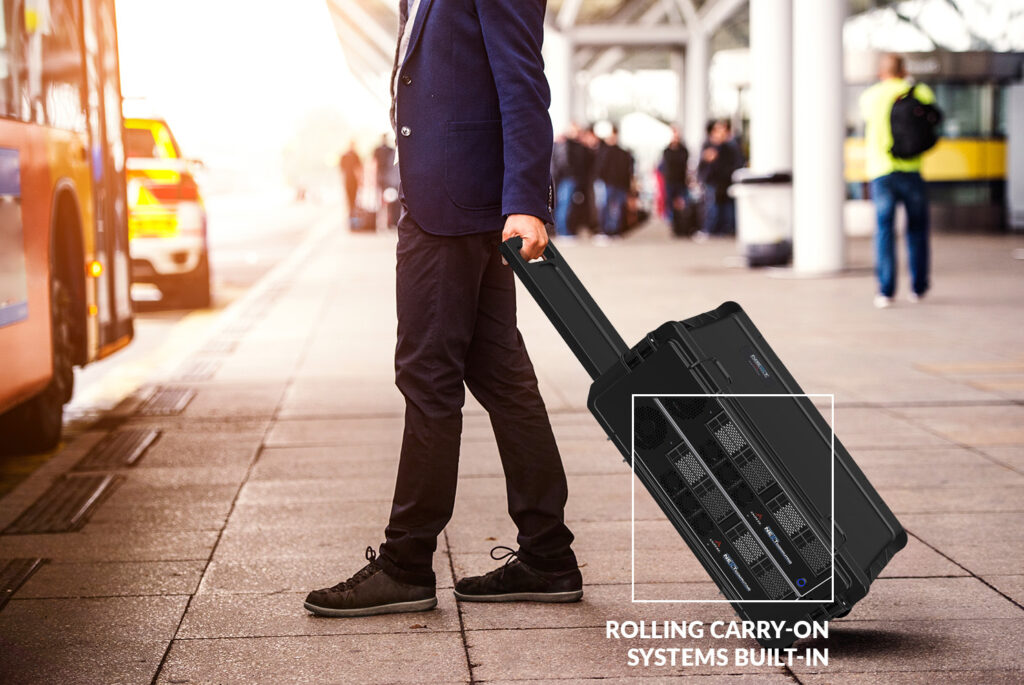
Fly-Away Kits
NextComputing Fly-Away Kits (FAKs) are a self-contained suite of equipment (hardware and software) in a compact, portable form factor for a variety of use cases where location and portability are key factors.
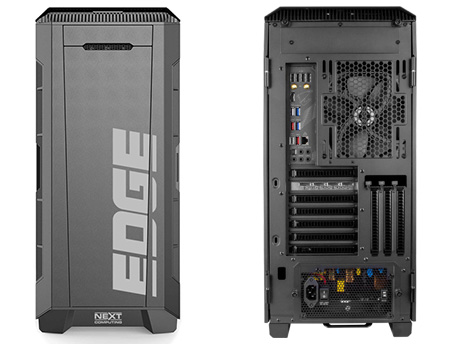
Edge XTP
The Edge XTP tower workstation is a professional-grade platform powered by the Ampere family of high-performance, scalable, power-efficient processors for demanding data-intensive, edge and cloud applications

NextServer-X
The intelligent, compact design of the NextServer-X allows for both easy transport and expandability. Whether you need cyber analytics in the field, or the flexibility to grow your toolset with your changing needs, the NextServer-X deployable server lets you bring your server applications to the network edge.